
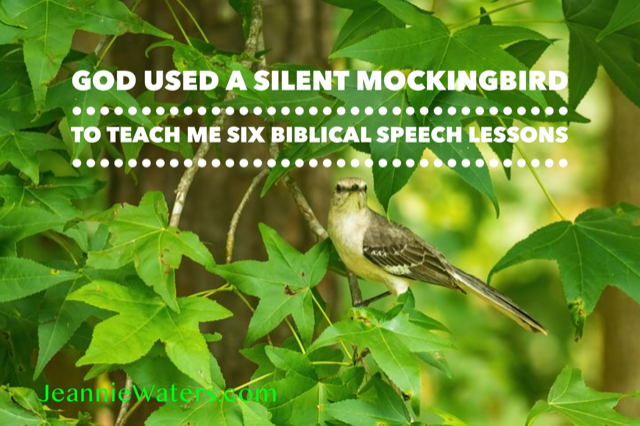
God used a mockingbird who didn’t sing to teach me a gentle lesson about wise speech. The bird flew from a neighbor’s yard and perched on our holly bush. Wrens, cardinals, and sparrows serenaded the day, but the mockingbird turned her head from side to side as if listening intently then flew away.
A few moments later she returned, perched on a hydrangea bush, and trilled her song as if she had an important message to convey.
How like this wise bird I want to be—not chirping and squawking constantly as soon as I arrive on a scene. I want to listen thoughtfully and wait for the right moment to share as God leads.
Confession: I’m a talker. I talk to family and friends. I talk to strangers in stores and elevators. And I talk to myself.
Sometimes I say too much. My intentions are good, but I realize the listeners don’t need to know all that I know—or think I know—about life and how to solve their problems. The gift of a listening ear speaks volumes.
The gift of a listening ear speaks volumes. Share on X
How often do we offer advice or interject our experience before a friend or co-worker finishes sharing her plight? I for one, need to listen and pray for wisdom before responding. What about you? God expects believers to share the gospel and encourage each other with words, but when we listen to Him before we speak, our words are more effective.

The psalmist penned a prayer to help us.
Let the words of my mouth and the meditation of my heart be acceptable in your sight, O Lord, my rock and my redeemer.
Psalm 19:14 ESV
As always, the Bible provides wisdom for all aspects of our walk with Christ, including our words. Let’s consider the following verses God used to help me evaluate my speech.
Six Biblical Speech Lessons
1. Avoid the “clanging cymbal” speech and speak with love.
If I speak in the tongues of men and of angels, but have not love, I am a noisy gong or a clanging cymbal.
1 Corinthians 13:1 ESV
2. Listen and wait before you talk.
Let every person be quick to hear, slow to speak, slow to anger.
James 1:19 ESV
3. Consider the timing.
. . . a time to tear, and a time to sew;
Ecclesiastes 3:7 ESV
a time to keep silence, and a time to speak.
4. Choose edifying words.
Let no corrupting talk come out of your mouths, but only such as is good for building up, as fits the occasion, that it may give grace to those who hear.
Ephesians 4:29 ESV
5. Season your speech with grace.
Let your speech always be gracious, seasoned with salt, so that you may know how you ought to answer each person.
Colossians 4:6 ESV
6. Select words carefully.
A word fitly spoken is like apples of gold in a setting of silver.
Proverbs 25:11 ESV
I’m thankful God used the silent mockingbird to teach me about biblical speech. I want my words to be like “apples of gold in a setting of silver.”
Here’s an encouraging word about our words:
Our speech can offer praise to God, share the gospel of Christ, console a hurting friend with the comfort God gives us (2 Corinthians 1:3-5), share wise counsel, express gratitude, and assure a friend of our prayers. What a blessing to use the gift of words for God’s glory and the good of others.
What a blessing to use the gift of words for God’s glory and the good of others. Share on X
Now it’s your turn to “talk.” Please share your thoughts about how we can honor God and encourage others with our speech. How has someone encouraged you with their words?
