
My daughter’s attention was riveted to the tale of a brave mongoose who protected an Indian family by fighting cobras. Proud of my efforts to introduce her to classic literature and convinced she was now old enough, I read the story she’d selected, a cartoon-illustrated version of “Rikki-Tikki-Tavi” by Rudyard Kipling.
Have you ever made what you deemed a wise decision but lived to regret it?
“I loved Rikki-Tikki-Tavi, Mama. He was brave. But, Mama, what if cobras get into our house? We don’t have a mongoose. Can we buy a mongoose, Mama?”
“Honey, cobras don’t live in our part of the world, and no, we can’t buy a mongoose.”
“But one could come here, and get under the house, and come into my room,” she responded.
“I promise you cobras don’t live in our country. Rikki-Tikki-Tavi lived in India, and the author made the story up. It’s not true. Now go brush your teeth and get ready for bed, and I’ll come pray with you.”
“But, Mama, one might come here. I can’t go in the bathroom. Ask Daddy to check it first.”
Even after my husband checked, our little bookworm refused to budge from the sofa.
Oh, I know what I’ll do. Surely this will convince her.

“Let’s look at the globe. Here’s where we live, and waaaaaay over here, on the other side of the world, is India. That’s where the story took place. Look at the huge oceans between us and India. See? No cobras can get to us.”
“They might be able to swim, Mama.”
Why did I read that story at night? Why did I read it at all?
No amount of words or geography lessons from tired parents could solve the argument.
Maybe if she talks to Daddy. She thinks he knows about everything, especially animals.
“Hey, I have an idea. Why don’t you call Granddaddy and ask him about cobras?”
She called my dad and returned from the kitchen smiling. “Granddaddy said cobras don’t live here. They live in India, and that’s far away. Granddaddy knows everything. I’m going to brush my teeth. Can we read “Rikki-Tikki-Tavi” again tomorrow night?”
What? That’s exactly what we said. But she believed her grandfather because “he knows everything.”
Whom do you believe when you face fears? During the Covid-19 pandemic we hear advice from an alphabet soup of “experts.” CDC, WHO, FEMA, FDA, FOX, CBS, CNN, etc.
In addition to the acronyms, we’ve garnered advice from pastors, family, friends, social media platforms, and others. “Facts” presented by one source are disputed by another or changed the following day.
Three feet apart or six? Wear masks or don’t? It’s safe to go out; no, it’s not. Asymptomatic persons can carry the virus; no, they can’t. The conflict can frighten us and rob us of sleep.
Whom are we to believe? Who is credible? Are our sources basing their commentaries on God’s Word?
Satan, our enemy, uses fear to attack our peace, a fruit of God’s Spirit within believers’ hearts.
News updates serve a purpose, but they can also become incubators for panic. What protection does God’s Word offer?
When David faced physical enemies in battle, he said,
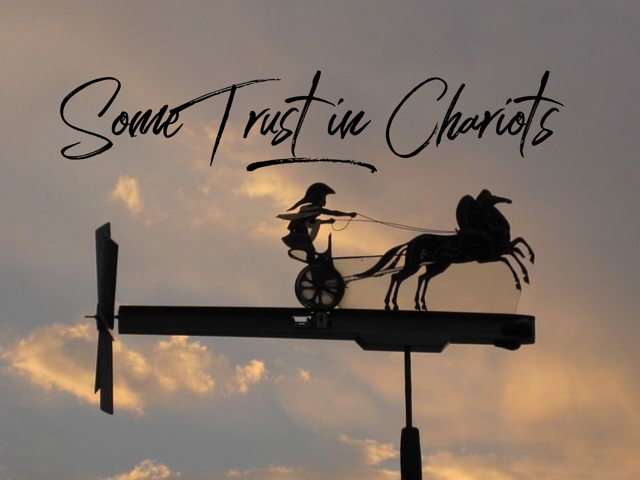
Some trust in chariots and some in horses, but we trust in the name of the Lord our God.
Psalm 20:7
Some of David’s enemies depended on horse-drawn chariots and mighty warriors to wage war. Armies with this equipment and personnel often decimated opponents on the battlefield.
When fear rears its ugly head, it’s easy to turn to the arsenal of strategies we’ve used in the past with some measure of success. Although we should utilize God-given skills and resources, placing our faith in God is vital if we are to win against distress. His gifts equip us, but we depend on Him for victory.
Depending solely on our own abilities, money, the help of others or information brings short-term success at best and does little to yield long-term peace. Let’s ask ourselves: Where does my dependence lie today? Where do I turn when I’m afraid or anxious?
Some versions of Psalm 20:7 substitute remember or boast for trust. Surely David recalled the numerous times God granted him military and personal victory as he counted on continued protection.
Does remembering God’s work in your life fortify you to face uneasiness?
Remembering a few of God’s many names helps us focus on who He is—His character.
El Shaddai (Lord God Almighty)
Jehovah Shammah (The Lord is there.)
Jehovah Jireh (The Lord will provide.)
Jehovah Raah (The Lord my Shepherd) 1
Do one of these names of God or others comfort you in otherwise scary times?
In child-like faith, our daughter believed her granddaddy because of his proven record with her. In child-like faith, we can run to our Abba Father when enemies assail us. He actually DOES know everything and He cares for us.
Meditating on God’s names and His character reminds us of who He is. Perhaps in the face of battle, David focused on God’s faithfulness, His sovereignty, or His strength. Maybe at other times, the shepherd-king considered God’s lovingkindness or His longsuffering with His people.
Which traits of God help you to trust Him?
Whether our fear stems from the coronavirus, relational issues, financial concern, events in the news, or other sources, God’s names and His character remain the same. I hope you find encouragement today in the peace God offers to His followers. Jesus said,
Peace I leave with you; my peace I give to you. Not as the world gives do I give to you. Let not your hearts be troubled, neither let them be afraid.
John 14:27
Try listing the names of God and His character traits. Concentrating on one per day and finding related Bible verses helps us conquer anxiety.
Do you know someone who needs these truths? When the peace of Christ fills our hearts, others are drawn to Him. Hearing the way God calms our fears can encourage someone else.
Please share how concentrating on one of God’s names or an aspect of His character helps you fight fear.
This week when news alarms us, let’s say with David,
…We trust in the name of the Lord our God.
Psalm 20:7
Bible verses are from the ESV.
1 https://www.blueletterbible.org/study/misc/name_god.cfm
Images from Pixabay.com